
Prioritising Customer Experience in the Connectivity Industry

On Episode 6 of The Connectivity Matters Podcast we sat down with Richard Hart, the Global Connectivity Director at Quectel. Richard’s career has spanned over 15 years, working with connectivity giant Vodafone before moving to Quectel in 2021 to lead their global connectivity proposition. We spoke to him about how focussing on customer experiences can bring the industry forwards. 

How do you approach customer experience as you scale up a quick sales connectivity business?

Customer experience has been our focus now for a long time. The customer is genuinely at the heart of every decision we make. Patrick, our co-founder and CEO, is always out talking to customers, and that feedback comes right back into the organisation. We value seeing the world through the customer’s eyes, understanding how what we do impacts the customer and how the customer subsequently behaves. Understanding those behaviours helps us shape their experience. You also need to accept that things go wrong, mistakes happen and technology crashes. Being honest about that and learning from it will make your customer’s experience better. They’ll trust you to fix it even when things do go wrong, because they know you won’t repeat the same mistakes. 

How would you ensure consistent customer experience when looking at a number of product lines which can be sold separately?

You have to take a step back and look at things holistically and understand the impact of the individual components. It’s important to understand that if you do something on one product, that will impact everything else as well. Whilst we put the customer at heart of everything, we still have a job to do. We still have a business to run. What we do is focus on collaborative working between departments and developing healthy behaviours. If you are going to deliver a superior customer experience than your competitors, you need a continual evolution of processes and services that meet your customer’s needs. Whenever you change things, think about how that impacts the customer, and communicate the changes clearly. 

What can be learned from having different interactions with a particular customer for different products?

Customers have three or four contact points with an organisation. Those contacts have to talk to each other, because the customer expects you to know what your colleague is doing and if it’s going to impact them. Does the left hand know what the right hand is doing? It should! From a competitive point of view, providing that information will keep you ahead, because again, it’s about good customer experience. That’s why internal communication is so important, because it allows you to feed back all the different points of view and build your team as a whole. 

What does a good customer experience actually look like?

We all have companies and brands that we think of as good and bad, so I try to get my team to think about that when they’re creating customer interactions. We all know what it feels like to have a positive experience with a company. Good customer experience is just the basics. It is about communication. It’s also admitting when you’ve got a problem. It’s being transparent in terms of ‘this is what we’ve done to ensure it doesn’t happen again’, or ‘we’re investigating a new follow up’. That’s all it is; doing right by people. 

There’s a standard that customers expect when they interact with you. Whether they use a phone or a self service platform, there are basic products and solutions that underpin your customer experience. Some things are really important to customers and if you understand what you’re supplying, you need to put service levels around that. Accommodating the customer experience is based on what vertical and solution it’s supporting. You need to get that infrastructure in place. 

To hear more about putting customers at the heart of your connectivity company, tune into the full episode of The Connectivity Matters Podcast here

We sit down regularly with some of the biggest names in our industry, we dedicate our podcast to the stories of leaders in the technologies industries that bring us closer together. Follow the link here to see some of our latest episodes and don’t forget to subscribe.     
The Future of In-Home Connectivity

The Connectivity industry has been leaning towards the in-home market for some time. Improving networks and the development of Smart Home technology has seen consumer expectations rise, putting strain on service providers. On Episode 5 of The Connectivity Matters Podcast we spoke to Shane Paola, the VP of sales at Plume Design, about how in-home technology is shaping the industry. Plume Design is creating a new category of Smart Home experiences, leveraging cloud and AI, which Shane unpacked with us. 

Read on to find out what challenges are currently facing in-home connectivity providers.

What’s the current state of the Connectivity industry?

It’s about the in-home experience right now. We’ve built these phenomenal networks, so customer expectations are extremely high, they want to add more devices into their homes than ever before. The rise of connected homes and devices within our clouds isn’t slowing down. People are embracing Smart Home technologies, so connectivity inside of the home is becoming increasingly important. Companies are trying to support the needs of customers on their Smart Home journey, while also delivering the experiences that people expect from the bandwidth they’re subscribing to. 

What are you most excited for about the future of the Connectivity industry?

It’s all heading for personalization and the in-home experience. One service provider has basically gone from managing five or six tariffs and cut it down to two. They’ve said, ‘Here’s our basic package, it’s £29.90 a month and you get this minimum level of service. Or there’s our max bundle.’ They’re not advertising speeds and feeds, they’re just saying, ‘We’re gonna give you the greatest in-home experience with the best WiFi mesh environment, covering your house with connectivity. You’ll always get the maximum available bandwidth when it’s provisioned in your area and you never have to worry about it.’ That’s a phenomenally bold and disruptive move, which I think the rest of the industry should look at. Customer dissatisfaction and negative experiences create a churn from one provider to another, which is a nightmare. Providers have to manage sunsetting tariffs and trying to move their customers onto new platforms as well as trying to retain their customers. It’s a great sign that companies are starting to move their focus on customer experience rather than the speeds and feeds.

Which use case would you find most useful in your home that you don’t currently have?

I want to see a Smart Home environment. Different vendors are building things that don’t necessarily interoperate with each other, so it’s hard to create an integrated system. There’s a fair bit of buzz around the new Matter system and its potential. IOT bodies are building towards the Matter framework, which will hopefully standardise things in terms of internet connectivity in Smart Home environments. What we’re missing is simplicity. Big companies typically compete at a device level or an application level, but they need to realise that for the best customer experience they need to collaborate. That’s what I want to see happen in my home.

To hear about the work Shane and Plume Design are doing to advance the industry, tune into the whole episode of The Connectivity Matters Podcast here. 

We sit down regularly with some of the biggest names in our industry, we dedicate our podcast to the stories of leaders in the technologies industries that bring us closer together. Follow the link here to see some of our latest episodes and don’t forget to subscribe.     

How New Companies Can Compete With Legacy Businesses

On Episode 6 of The Satellite & NewSpace Matters Podcast we were delighted to be joined by Emile de Rijk, the CEO and co-founder of SWISSto12. Emile has successfully made the transition from academia to startup co-founder by taking his PhD in physics and applying it to the real world. They use patented 3D printing technology to create a range of RF products and systems, including a new HummingSat range. In this bite-sized blog we dive into Emile’s experiences of disrupting the Satellite & NewSpace industry as a small business, and tap into his expertise as a leader in our sector. Read on to hear his insights.

Your growing business is in an exciting phase of development. How do you keep growing?

We started small with an initial product in technology focus, but we’ve always been able to adapt to the market and the voice of the customer. There are always ideas and challenges to inspire us. In that respect we’ve moved from building single waveguides to full satellites. That gives away the DNA of the company, which is to always be ambitious, look at the next big problem that we can solve and then go do it pragmatically without debating it for ages. That creates an exciting working environment that enables us to take initiative and go one step further in solving complex problems and developing exciting products.

There are a number of small businesses trying to compete within the satellite industry, which is saturated with legacy businesses who have been around for a long time and have been successful. There is an ecosystem of smaller businesses like yourself trying to break into that space. Why do you think the satellite industry is like that?

The satellite industry has a huge entry barrier. If you sell a satellite, it’s not like you can send someone up there to repair it. The consequences of failure are huge and extremely expensive. You have to develop products that are proven and reliable, and that someone can trust with an investment. That’s the major entry barrier. To overcome that you just need to accumulate a lot of knowledge, partner up with the right companies and suppliers and build a product that will fulfil the mission. The nature of that technical difficulty is such that it makes it very difficult for newcomers to actually come in. 

It’s possible if you’re patient and thorough and you work hard, which is what we’ve done so far. It’s a very exciting business to get into, because coming up with great products that are engineered correctly and fulfil the needs of the customer is highly rewarded by the industry. 

The other way to get into this market is to not compete with the incumbents. Why? Because the incumbents are there for a reason. They have launch experience and they’ve optimised their products for decades. They have a great offering. Our strategy has never been to compete in that market, but rather to find new markets that are not addressed, where we can create a different product that is complementary to what the big incumbent players propose. 

On top of that, our way to get from a radiofrequency product manufacturer to a satellite manufacturer has been to team up with players and suppliers and reuse satellite subsystems that are not worth reinventing. We are really innovating around payload and RF technology, which is our focus. Our innovation is in developing a smaller spacecraft that fulfils different types of missions. We work with heritage and legacy suppliers and partners to procure all the subsystems that benefit from heritage and just need to be integrated differently into a smaller spacecraft to make it a success. It’s a very collaborative strategy within the Satellite ecosystem to build this new success around smaller geo satellite missions.

All in all, the trick to successfully entering the industry is to use it to your advantage by creating a space for yourself and working alongside those bigger legacy companies instead of against them. 

To hear more about Emile’s fascinating work in the Satellite & NewSpace industry, tune into the full episode of The Satellite & NewSpace Matters Podcast here

We sit down regularly with some of the biggest names in our industry, we dedicate our podcast to the stories of leaders in the technologies industries that bring us closer together. Follow the link here to see some of our latest episodes and don’t forget to subscribe.     

Space in the Future

We recently sat down with Laurynas Mačiulis on The Satellite & NewSpace Matters Podcast, where we talked about the future of the NewSpace industry. Laurynas is best known for launching Lithuania’s first satellite, which sparked the NewSpace company NanoAvionics. Today, NanoAvionics is one of the largest small satellite mission integrators in the world. But Laurynas Mačiulis didn’t stop there. In 2019 he helped co-found Astrolight, an advanced laser communication system for space, where he remains the CEO. With those credentials it’s easy to see why his thoughts on the future of space are so interesting!

What is the future for space?

There are always people who are pessimistic about investing anything in space, who think they should just make life better on Earth. We don’t need to put in a contradiction, we can do two things together. We can progress in space without sacrificing life on Earth or taking away from progress on Earth. It’s really complimentary. 

The philosophical question of ‘What is our future in space?’, even without the worry that something bad would happen here, is always really interesting. Our destiny as a species is actually to go further and explore. We don’t need to stop on Earth, we need to go further. I think that’s our destiny. Space transportation is probably the technology that will have to pave the way for this ability. Exploring whether life exists on other planets is a fascinating question that needs to be answered. 

When the space shuttle transportation technology reaches a level where it is affordable, space travel, space tourism, asteroid mining, building hotels in space, and maybe some remote colonies in other space stations and other planets is going to happen. When that happens, the other stepping stone will also be how to communicate, because we would need to be in touch. Information is something that connects us. Laser communication will play an important role there to actually enable that. 

Do you think people living in space is something that’ll happen in our lifetime?

I definitely think that we would have more of a presence in space. It’s my dream to see people landing on Mars. That would be a very important milestone in our evolution as a species. Even such simple things like giving ordinary people the chance to see from space would be a fantastic achievement, because I would compare it with the moments in our history where part of our civilization went to the other lands. There were some bad things that happened with that, but there were also a lot of good things where new ideas emerged. We could also see some very interesting developments from societies living in space and maybe coming up with better ways to organise society. The fragile connection that we have between space and earth is the transformational feeling that astronauts are always talking when they see Earth. Imagine if everybody could feel that, I think that could change our whole attitude to life. Fundamentally, I’m quite optimistic about space travel. It’s not just for a million years’ time, it’s definitely the goal for my lifetime.

To hear more about the work that Laurynas is doing to advance the NewSpace industry, tune into the full episode of The Satellite & NewSpace Podcast here

We sit down regularly with some of the biggest names in our industry, we dedicate our podcast to the stories of leaders in the technologies industries that bring us closer together. Follow the link here to see some of our latest episodes and don’t forget to subscribe.     

What are the issues facing “connecting the unconnected” in the African continent?

On Episode 1 of The Satellite & NewSpace Matters Podcast we were thrilled to welcome Scott Mumford, CEO of Liquid Telecom Satellite Services, and now CCO of Liquid Dataport. Scott has a very impressive 25 years of experience in the industry, starting as an Engineer through to C-Suite.  

We unpacked so many interesting topics in this episode, our favourite highlight is below! 

What do you think is the key to helping those without connectivity get connected? 

There are a number of factors, so I wish there was just one answer, because then it would be easy to deliver. The technology gap is, is one that we need to solve, for sure.  

If you look across the African continent, generally, there are hundreds of millions of people without access to the internet. Internet penetration rates across the continent are around sort of 34%, which is the lowest globally. Some of that comes from the sheer size of the continent.  

I think a lot of a lot of people see Africa on a map and go, “yeah, it’s relatively big”, but, the maps are quite deceptive – it’s vast. I’m sure we’ve all seen those maps, where you can see the US and India and China and Europe and everything all sort of fitting within the African continent from a landmass perspective.  

The second element of that is really where technology is gone. If you look at you, me, and everybody else, everything really has moved towards applications and handset-based usage. Banking, shopping, travel, you name it, are all pretty much done from a handheld device these days.  

And, that really hasn’t spread into the African continent, partly from a cost perspective. It’s a bit of a vicious circle, there’s no network because there are no handsets, and there are no handsets because there’s no network.  

So, where do you go first? But I also think, you know, a lot of those, a lot of countries around Africa are still very cash-based economies as well,  because of the lack of connectivity and devices, the move to a digital banking and finance sort of architecture hasn’t taken hold as yet, either.  Dealing with a number of currencies in physical cash is another complication, that that has to be overcome.  

It’s a multifaceted problem that isn’t just on the communications industry, or the satellite industry. It’s the banking sector, the manufacturers, it’s a big, big melting pot that everybody needs to put into.  

There’s a lot of progress going on there and satellite to sort of bringing it back, that’s playing a massive role in the sense that we’re seeing huge deployments of visa terminals and satellite terminals and satellite connectivity across the continent.  

To listen to the full episode, click here.  

We sit down regularly with some of the biggest names in our industry, we dedicate our podcast to the stories of leaders in the technologies industries that bring us closer together. Follow the link here to see some of our latest episodes and don’t forget to subscribe.     

Space Tech Expo Europe – Day 3

The third and final day is here and that can only mean one thing – scrambling for swag. Beyond the frantic grabbing of goods, there was a wonderful murmur of meetings, conference talks, and general excitement about the success of Space Tech Expo 2022. 

We were delighted to see the continued levels of attendees right from the start of the day until the very last moments, soaking up every minute of Space Tech Expo possible. Easy to spot were the sore-headed attendees of the Telespazio after-party last night walking the halls with glossy eyes. After all, even though it’s the final day, the show must go on.

And go on it has! It’s been delightful to see the continued enthusiasm and high levels of attendees today. We’ve seen everything from robots roaming to holograms to satellite demos and a vast array of space tech in action. 

Today’s conference talk highlights include a great discussion on the ever-looming issue of space traffic and collision management. It was fantastic to see some of the best minds in the industry coming together to tackle what will prove to be a massive obstacle for the issue in the coming years with the rise of mega-constellations. This was followed by what was a great way to finish an incredible array of talks from the three conferences – the innovation spotlight presentations.

Now, sitting in Bremen airport reminiscing about the great event that Space Tech Expo 2022 truly was, I can’t wait to see what next year has to offer! 

Today, Bremen really feels like the “City of Space”. 

Space Tech Expo Europe – Day 2

While outside the conference centre it might be cold, grey and raining, but you’d never know it from the buzz of excitement inside. 

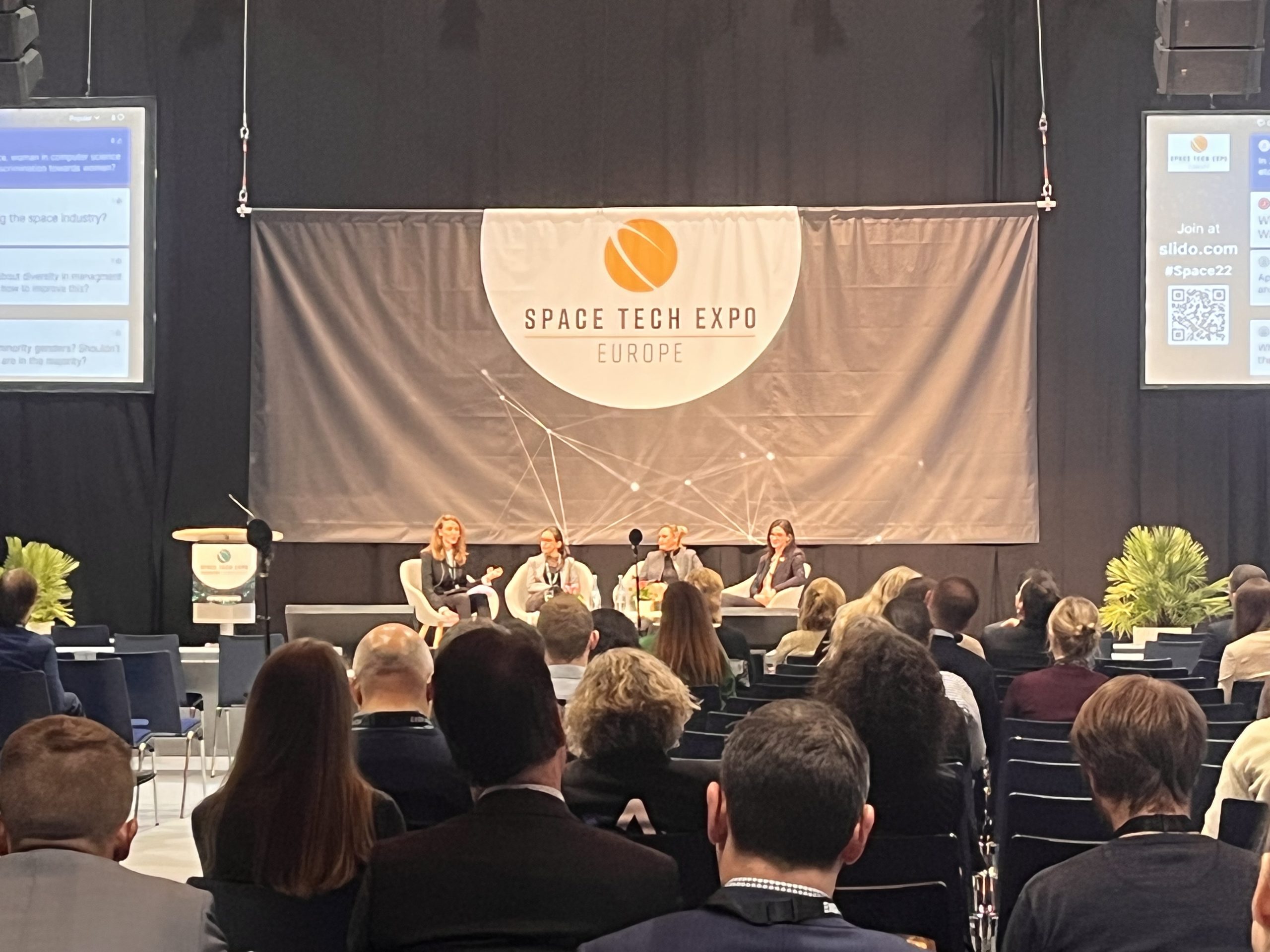
Day 2 promised another packed day of meetings with existing clients, new companies and a whole host of fascinating talks on a variety of topics. The most important being not 1 but 2 “Women in Space” panels, which, if you’ve ever listened to our podcast “Satellite and NewSpace Matters”, you’ll know is a topic that sits close to our hearts. It’s obvious the industry has made great strides in addressing the imbalance, walking around the convention centre it’s clear there is a lot more work to be done! 

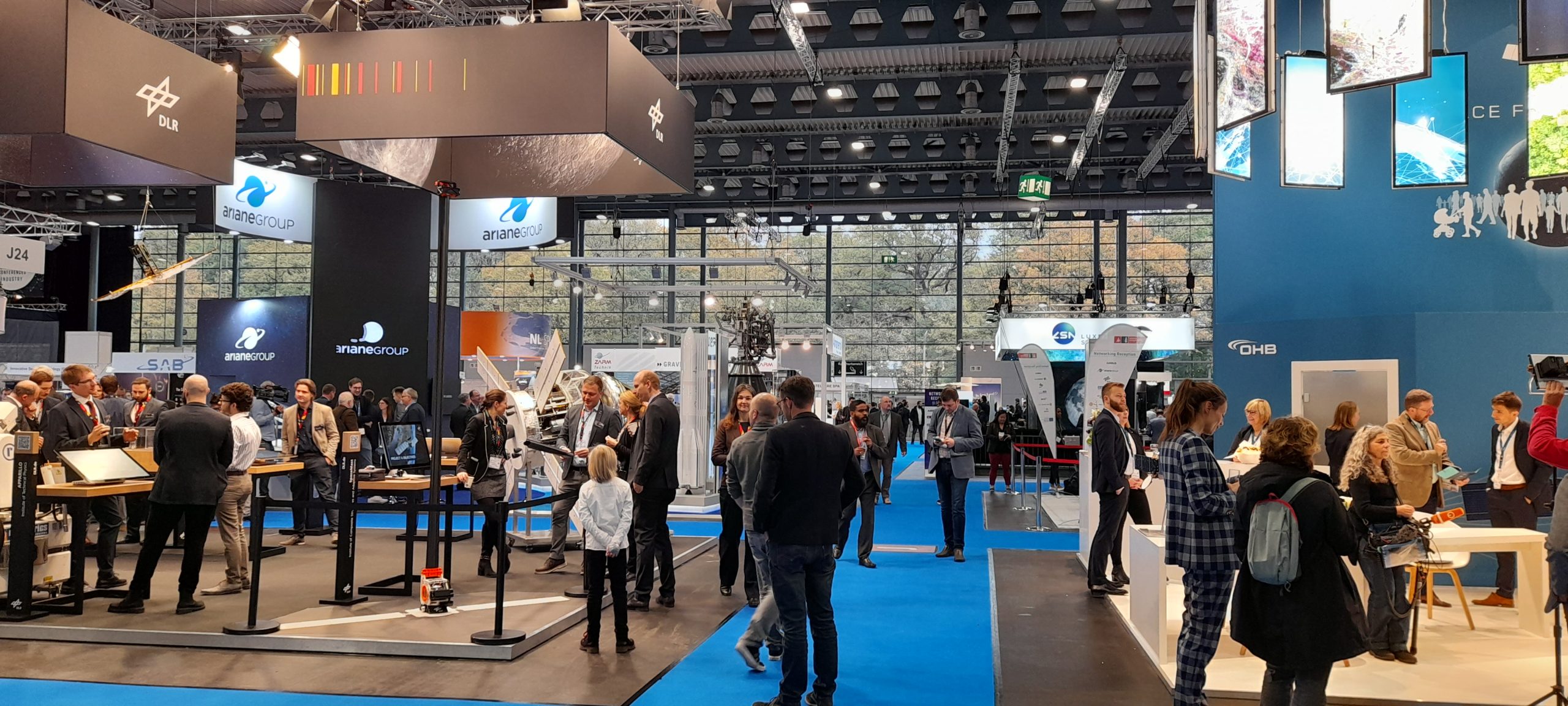
Walking around today it’s so obvious that day 2 is so much busier than day 1, which itself was still busy. Every booth is packed, all the B2B meeting tables are constantly booked up and meetings are spilling out into the foyers and any available floor space people can find. Hopefully, this bodes well for the future of the industry and I am sure we will see a large number of post-show announcements and partnerships in the days to follow. 

If you are here tomorrow, I would suggest heading to hall 6 for the final day of the LeanSpace hackathon. It’s been so great to see the real-time requests coming in for the teams in competition with each other and if you have some time, why not challenge them to find you something obscure. 

Anyway, we’re off to enjoy a drink, or two, at the post-show Telespazio networking event. Let’s see how many sore heads we can spot tomorrow morning. 

Space Tech Expo Europe – Day 1

Day one of Space Tech Expo Europe 2022 delivered on the buzz that was palpable upon first entering Messe Bremen’s Halle 4 on a crisp German morning in the City of Space.

The multitude of masks that dominated the show last year was instead replaced by the smiles of individuals grateful to be back at a show that immediately seemed more familiar to the pre-covid 2019 version than its 2021 counterpart.  

The 3 halls seemed busier, filled with people catching up with, or making introductions to, the many established and lesser-known space companies in attendance. The highly innovative and diverse technologies on display fuelled conversations, solidifying current and inspiring new collaborations. And with 3 Conferences this year, we were spoilt for choice.

The Industry Conference gave us insights into the latest updates and key trends in the space sector. The SmallSats Conference allowed room for discussion relating to ongoing and upcoming developments in the ever-growing Small Satellite market. And the Mobility Connectivity Conference saw panels focused on discussing on-the-move connectivity in maritime, land and aviation markets, and the ecosystem that drives it.

As the day drew to a close, conversations and drinks flowed as music rang out across the halls to cap off what was a great first day and true return to form for Europe’s largest gathering of space companies and enthusiasts. Roll on day 2!

How does working for a business with one vertical strength impact its diversification into other verticals?

On Episode 4 of The Connectivity Matters Podcast we spoke with Erik Carlson, the SVP of sales for Maritime, Energy and Government at Anuvu. With over 20 years of executive leadership experience, growing and driving revenue across the likes of Panasonic Avionics, ConvergeOne and Hitachi, Erik deeply understands the industry and has plenty of enthusiasm for revenue generation. 

We spoke about his experience across a variety of industries and how important it is to focus on the customer at all levels of the business. 

What advantages do you have coming from a different industry into connectivity?

The pace at which I work and we run our teams is much higher than a lot of the people who’ve come out of the satellite community. A lot of them have old government roots, which means they tend to move a little slower. My background is much more Silicon Valley. Think about it in context. How are they operating? How are they thinking? How are they iterating on technology? That’s my world. There’s a professional ruthlessness that needs to be respected, and I try to operate in a very similar fashion. The fact that I came from different industries gives me different perspectives on learning customer markets incredibly quickly. While everything I do is about global connectivity below the clouds, we also have an aviation and aviation entertainment business. Below the clouds, those are all different customers, who have different end user requirements. My advantage is my ability to learn that voice of the customer, and to really care about that customer, that’s allowed for the speed at which these successes have been happening for us.

How have you gone about learning the voice of the customer?

I always work from the customer backwards, I do everything in reverse. Look to identify how something is getting to the customer. It’s not the guy who buys connectivity, it’s who his customers are. We need to map not just where our clients are operating, but also what their itineraries and routes are, and who else is in the area. If you look at oil leases, they are basically divided up plots of land out in the ocean, and you can see other rigs from yours. Similarly, each satellite is able to pump down a certain amount of capacity on Earth in a single place. Starlink is doing some brilliant things to amplify that, but if there’s only one legal provider on the planet, and everyone wants that service, you’re going to have a pinch point there. It’s great for me to talk about my customers, but if I’m not taking care of their entire ecosystem, I’m not a partner. There’s a lot of dynamics there, which are going to come into play. If you start with your customer, you’ll have a guiding light upon which to lead the business.

How do you find working for a business with a track record and visibility in one vertical, and how does that impact the verticals that you’re in charge of?

The biggest thing I look at is the leadership team. It’s all about understanding the leadership team’s exit strategy timeline and their worldview. Anuvu brought me on their mission, and their passion was to commit to this business, and that’s what I was looking for. The other thing happening there is that results drive decisions. What we’ve seen is that the business below the clouds is growing phenomenally, and there is an incredible harmony of above the clouds and below the clouds connectivity. Everyone looks at their customers uniquely, but there’s so much in common there and the leadership team here at Anuvu has been really clear about how we think about ourselves. 

Externally and historically, Anuvu has always been seen as ABA question, but what we are seeing is a lot of those customers who tried greener pastures elsewhere are realising that it wasn’t actually greener and they’re coming back to us. Another advantage in my role is that we are seeing customers that have explored other venues and had 2, 3 or 4 years and aren’t seeing the results, customer service or the care that they wanted. The Anuvu rebranding has been really important to help continue and maintain that below the cloud business. 

To hear more about the work that Erik and Anuvu are doing in the Connectivity industry, listen to the whole episode of The Connectivity Matters Podcast

We sit down regularly with some of the biggest names in our industry, we dedicate our podcast to the stories of leaders in the technologies industries that bring us closer together. Follow the link here to see some of our latest episodes and don’t forget to subscribe.     

The State of Space Sector – Satellite production may not be up to speed with industry growth & launch predictions

On Episode 4 of The Satellite & NewSpace Matters Podcast we spoke to István Lőrincz, the president and co-founder of Morpheus Space. Morpheus Space are innovators of the world’s most efficient and scalable satellite propulsion systems and a key driving force of next generation space tech across several areas within the industry. We spoke to István about his experiences in the industry, from how he got into it to what he thinks its future will look like.

What is your take on the current state of the space sector?

I represent a controversial perspective on the industry, because I think that the industry is definitely on the right track. Certain aspects of the growth of the industry haven’t been great, and that will cause inevitable delays for the entire industry when it comes to reaching our projection. Right now, that projection is solely based on the capacity of the launchers, and nobody actually took a detailed look at what the capacity of the industry is to build satellites. If you look critically into it, the industry isn’t able to build as many satellites as we’ve projected. It’s just because of the nature of the industry. It’s emerging, which means that it’s highly segmented and there are a lot of small companies just like us, however, what’s missing in all of those other companies is the buy-in to the growth of the industry. You have to lean into it, you cannot be reactive in this environment, you have to take the responsibility and be proactive and lean into those projections. If you see that, in three years, there’s gonna be 10 times as many satellite launches, you have to work with those numbers for whatever you produce. You need to make sure that your trajectory brings you to the place where you can make 10 times more components, for whatever you’re building. That’s what’s lacking; everybody’s too cautious. We need to talk about this, someone needs to do analysis and uncover hidden capacities, primarily in the western world, because that’s represented in a consolidated market.

What are your expectations for the next five to ten years in the industry? 

We have an internal project where we are conducting market analysis to assess what the capability of producing satellite components of the industry is, and what it will be in the next two to three years. If we see a discrepancy there, we will look at solutions of how, for example, the government could incentivize companies to focus more on adapting mass production capabilities and scalable ways to conduct their business. In most small companies there are no processes or tools in place that would allow the handling of 100 clients or 1000 clients, that’s such an enormous number that most small companies would not be able to handle.

I have a feeling that that is being revived. There’s excitement around space exploration that was at its peak during the Apollo programme, and since then it’s slowly diminished. Now we are seeing this new wave of interest, this new wave of random, unconnected industries utilising this excitement and trying to attach their brands to something that’s spacey or something like that. Young people are excited about space again, even if they don’t understand the technical intricacies. It has become something to look forward to, it has become a beacon of hope. That’s growing, and it’s giving me goosebumps. That is something that I strongly believe we need to push in order to inspire the next generation, because that’s where the majority of the revolutionary changes will come from. Young people are the future of the industry. 

What gave us the success that we are seeing today?

It’s the unique technology. At the end of the day, we want to steer the customers away from that question, because the satellite operator does not care what technology is in the satellite, but rather what that technology enables the operator to do. Through our new hardware as a service model, the question has changed. The question that should be asked is ‘What is the price that you can provide to your customers for a unit of change in orbit for their momentum or velocity?’ That’s the question that we are trying to lead the industry towards. 

What distinguishes us from the bulk of the propulsion systems is our use of metal as propellant. That metal is stored in a solid state in the heart of the thruster, so it’s already integrated. Everything is tightly integrated and compact. With traditional propulsion systems, you had to procure the thruster, the propellant tank, all the piping and all the valves and sensors and flow sensors, and so on and so forth. Usually that ordeal was so complex that you had to design the satellite around the propulsion system. Our system is not like that.  You basically purchase it from us and you get a neatly packaged array that you just screw into your satellite, plug in one connector and you’re done! That’s the biggest upside of having a plug and play and complex system. Integration of components into a satellite is an ordeal and you want to make that as easy as possible there. There are companies out there where the core of their business is making integration. Let’s look at Antares; one of their primary objectives is to have a number of components in their offerings that are already optimised for integration, like easily integrating double components. 

Furthermore, the underlying physics that enables us to generate thrust is a new process. That process is highly efficient. The ionisation efficiency is a big component in every electric propulsion system. To date, this approach has the highest ionisation efficiency. If you have low efficiency, you lose a lot of energy just to create a fluid medium that you can use to generate thrust, so you want to have that as much efficiency as possible. 

There are other secondary technological innovations like our neutralizer. The propulsion system itself emits positive ions, and in order to maintain the charge balance of the spacecraft, you also have to emit the same amount of negative charges or electrons, which happens through a neutralizer. In most cases, you either have to use propellant to do that, or you have to heat up things at high temperatures, which leads to inefficiencies because it does not generate thrust. When you emit electrons or negative charges, usually those are not used to generate thrust, so they are lost. What we do is eliminate the propellant, we just use electrostatics and things called carbon nanotubes to extract and emit electrons, which improves our efficiency further. All those technologies together have put us in the position we’re in now to be making further advancements in our field. 

If you’d like to know more about the future of the satellite industry, tune into The Satellite & NewSpace Podcast from neuco, with new episodes monthly. 

We sit down regularly with some of the biggest names in our industry, we dedicate our podcast to the stories of leaders in the technologies industries that bring us closer together. Follow the link here to see some of our latest episodes and don’t forget to subscribe.