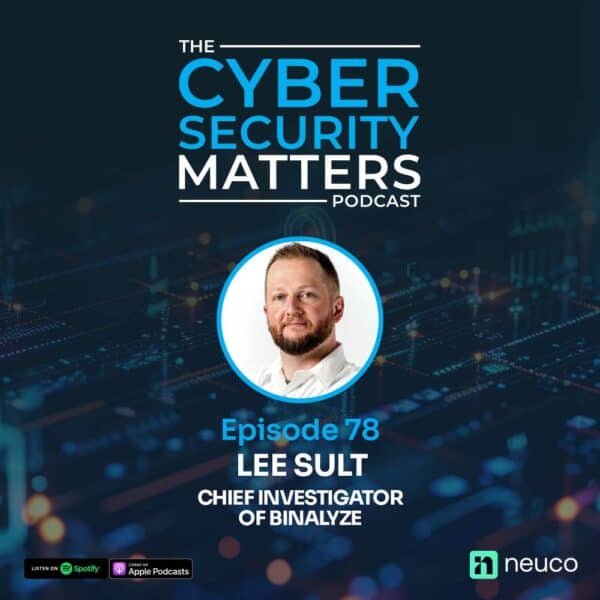

In episode EP 78 of Cyber Security Matters, hosts Matt Rose and Harry Baldwin are joined by Lee Sult, Chief Investigator at Binalyze, for a fascinating discussion on the realities of modern incident response and the evolving role of cybersecurity investigators. Drawing on a career that spans law enforcement, digital forensics, incident response, entrepreneurship and product development, Lee explains why understanding attackers is just as important as understanding technology, and why incident response must evolve as cyber threats become faster, more sophisticated and increasingly AI-assisted.
The conversation explores Lee’s journey from investigating cybercrime within law enforcement to leading investigations into some of the world’s most complex cyber incidents, before diving into how Binalyze is helping democratize digital forensics for security teams worldwide. Along the way, Lee shares practical frameworks for incident response, explains why evidence collection remains one of cybersecurity’s hardest problems, and offers candid advice for aspiring investigators looking to build successful careers in the industry.
Key Topics Covered
- From law enforcement to cybersecurity: How Lee’s early experience as a police dispatcher and digital forensic investigator shaped his perspective on incident response and crisis management.
- Thinking like an investigator: Why curiosity, authenticity and understanding attacker behaviour are the most valuable qualities for anyone pursuing a career in incident response.
- Democratising digital forensics: How Binalyze is making enterprise-grade investigations accessible beyond elite incident response teams by simplifying evidence collection and forensic analysis.
- The four questions every investigation must answer: Lee’s practical framework for determining whether attackers remain in an environment, identifying affected systems, understanding initial compromise and assessing data exposure.
- AI as a force multiplier for attackers: Why artificial intelligence isn’t necessarily creating more sophisticated attacks, but dramatically lowering the barrier to entry for less experienced threat actors.
- Using AI responsibly in cyber defence: Where AI genuinely accelerates investigations, where human expertise remains essential, and why accountability can never be delegated to machines.
- Why organisations over-invest in prevention: How the industry’s focus on detection and prevention has left many organisations underprepared for responding effectively when attacks inevitably succeed.
- Building high-performing security teams: The importance of diversity of thought, mentoring future leaders and creating environments where curiosity drives innovation.
- Breaking into cybersecurity in 2026: Lee’s practical advice on building a home lab, showcasing technical ability and demonstrating genuine passion to stand out during the hiring process.
About Lee Sult
Lee Sult is the Chief Investigator at Binalyze, where he helps organisations improve their incident response capabilities through scalable digital forensics and investigative technology. His career began in law enforcement, where he worked in digital forensics before moving into incident response, ultimately spending more than a decade investigating some of the world’s most complex cyber incidents. Along the way, Lee has held roles spanning consulting, product development and entrepreneurship, including serving as a founding Forward Deployed Security Engineer at Palantir and co-founding Huirangi. Today, his focus is on helping organisations investigate cyber incidents faster, empowering security teams with better forensic capabilities, and making advanced incident response accessible beyond specialist experts.
This episode is brought to you by neuco.